Quickstart
Generate and run a local AI agent, then add your planner, typed tools, and model integration.
Goa-AI extends Goa’s design language and generator to AI applications. Define agents, tool payloads and results, structured completions, policies, and evaluation scenarios. Generate the types, schemas, codecs, and bindings; write the planners and application behavior.
Build your first agent or follow the coding-agent workflow. You can start with Goa-AI without first deploying a separate Goa service.
Goa-AI makes the contract visible to both the developer and the coding agent.
Tool schemas and typed Go codecs come from the same design. A service-backed
tool can reuse an existing service’s types and implementation through BindTo.
Generation also creates AGENTS_QUICKSTART.md, a guide based on your
application’s agent design. Give that guide and the relevant design files to
your coding agent, then have it implement the planner and executors outside
gen/. Regenerate, compile, and run evaluations as the design evolves.
This keeps repetitive schema and integration work out of LLM authoring. It does not establish a fixed token-saving percentage: measure complete tasks, including context, retries, and review, for your application.
Define inputs and results using Goa types, descriptions, examples, and validation. The generator produces model-facing JSON schemas and typed codecs. The model boundary validates tool arguments before executor code runs. Toolsets explains service bindings, execution, and bounded results.
Declare a service-owned Completion(...) when you need a typed assistant answer.
Generated unary and streaming helpers validate the completed result.
See the DSL reference and runtime guide.
Declare suites and scenarios alongside the agent. Generate typed hooks and implement checks for the outcome your product needs. Semantic judging requires calibration; generated structure does not determine whether an answer is useful. See generated evaluations.
Expose an agent as a tool for another agent. Child runs have their own identity, parent links, and execution history. See agent composition.
The runtime emits typed events for assistant output, tool progress, human input, and run state. The application decides what to expose to its users and how to transport it. See production streaming.
Use the in-memory engine for local development. Configure the Temporal engine for persisted workflow execution, recovery, and activity retries. External side effects still need application-level idempotency and appropriate retry policies. See production.
Create MCP servers. Expose service methods as tools, publish resources, and provide prompt templates through generated protocol handling and adapters. Agents can also consume external MCP tools. See MCP integration.
Host a tool registry. Run the included registry server as a shared catalog and invocation gateway backed by Redis and Pulse. Providers publish toolsets and schemas; consumers discover tools and invoke healthy providers. Generated helpers connect applications to the registry. See hosting and operating a registry.
Use the provided model adapters for OpenAI, Anthropic, AWS Bedrock, and Google Vertex AI. Provider capabilities vary; consult the runtime guide when choosing structured output or streaming behavior. Your application supplies runtime storage and controls sessions, authorization, and product memory. See memory and sessions.
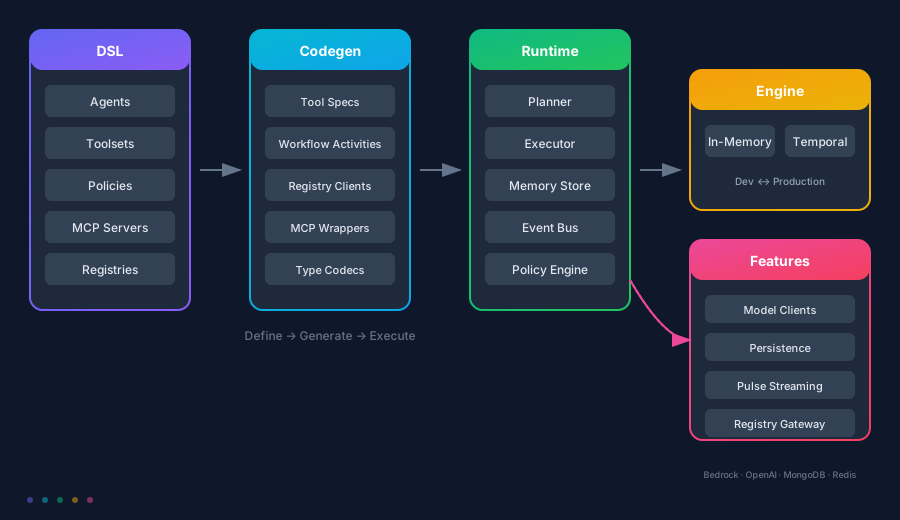
The design owns static contracts. Generated code turns them into typed packages. The runtime coordinates execution, and an engine supplies local or durable workflow execution. Planners own semantic choices; application services own business behavior.
Begin with the local quickstart. Follow task-oriented guides as you add tools, models, state, and deployment. Use the DSL and runtime references for exact contracts.